The Most Common Health Concerns for French Bulldogs—And How to Spot Them
From eye infections to breathing problems, here are health issues you should know about before adopting a French Bulldog.
From eye infections to breathing problems, here are health issues you should know about before adopting a French Bulldog.
by Dr. Maria Zayas, DVM, | December 1, 2025

LIGHTFIELD STUDIOS / Adobe Stock
Small in size, but large in personality and looks, French Bulldogs have become America’s most popular dog breed. If you’re thinking about adopting one, keep in mind that these iconic little dogs, while beloved, do come with a big list of health concerns that you should be aware of. From an obstructive airway syndrome to allergies, their health concerns are often long-term conditions that are very common in the breed and potentially expensive to treat. Catching things early helps keep these dogs comfortable and happy throughout their lives.

Shutterstock
French Bulldogs are a small- to medium-sized dog, usually weighing under 25 pounds. They are a brachycephalic breed, meaning they have short, flattened faces with very little snouts. In fact, they look quite similar to their English counterpart, another brachycephalic breed, except for their iconic upright ears. They also have a relatively large head for their small body size. Their large eyes, standing ears, and friendly personalities are why they’ve become such a popular dog breed.
While French Bulldog lifespans are listed as 10 to 12 years, recent studies of French Bulldog populations in different countries have found that their lifespans may be much shorter. This can be as low as four-and-a-half years, with averages ranging around six or eight years. It is critically important when bringing a French Bulldog into your home that you be prepared for recurring medical challenges throughout their life. This is what most impacts their lifespan.
Families love French Bulldogs because, while small, they aren’t too fragile to move freely in a busy household. They do well with children and strangers in most cases, and can adapt to high-energy play or couch-potato nap times with ease. You won’t find them drooling as much as similar breeds, and they have less grooming needs due to a very short hair coat. Beware, though, because they still shed an impressive amount despite having such short hair.
Most French Bulldogs don’t spend a lot of time barking except when greeting someone, but they are still quite vocal. They can be sassy, chatty, and generally engaged with you, which makes forming a bond with them extremely easy.

iStock / Hispanolistic
Here’s a list of the top French Bulldog health conditions.
Approximately 90 percent of Frenchies are born with one or more obstructive-airway conditions. Due to their short snouts, all the anatomy for their upper airway is squeezed into a much tighter area, causing a number of airflow problems. This family of issues is known as Brachycephalic Obstructive Airway Syndrome, or BOAS. The main components of BOAS are as follows.
Stenotic nares: These are tight or pinched nostrils that limit how much air can pass through the nose.
Elongated soft palette: This overlong flap of tissue at the back of the throat covers the windpipe opening. Airflow here is very tight, causing snorting and snoring.
Large tongue: They have a tongue that is too large for their mouth and also blocks the entrance of the windpipe, while pressing the soft palate in the back of their throat into obstructive positions.
Hypoplastic trachea: The trachea, or windpipe, can collapse when a dog takes a breath if the walls are too thin and the negative pressure is too strong (like a vacuum). When the tongue and soft palate close the opening of the windpipe while a Frenchie is trying to breathe, that creates the negative pressure that can cause the walls of the windpipe to collapse and trigger a cough.
All this negative pressure over time causes a number of significant, secondary health issues, as well as permanent changes to their airway. You can tell if your French Bulldog is showing signs of BOAS if they are:
Snorting
Snoring
Persistently panting
Pant with their tongue out
Wheeze
Have a high-pitched whine or whistle to their breathing sounds
Are generally noisy breathers
Have a blue to purple tinge to their tongue at times
Cannot run, play, or be in the sun for more than a couple of minutes without showing the above signs
The good news is that almost all Frenchies can benefit from at least one corrective procedure for BOAS. They can start as young as three to four months old and may need a series of surgeries to open up their airways over time. The surgeries are generally safe and very effective.
Be sure to purchase pet insurance as soon as you plan to welcome a Frenchie into your home. You should be careful choosing your insurance plan, because many exclude these surgeries from coverage due to how often they are needed for brachycephalic dogs.
Frenchies who haven’t undergone these surgeries are prone to episodes of collapse, heat stroke, seizures, heart and lung disease, and more — so making a plan to deal with their BOAS needs should be a top priority.
hedgehog94 / Shutterstock
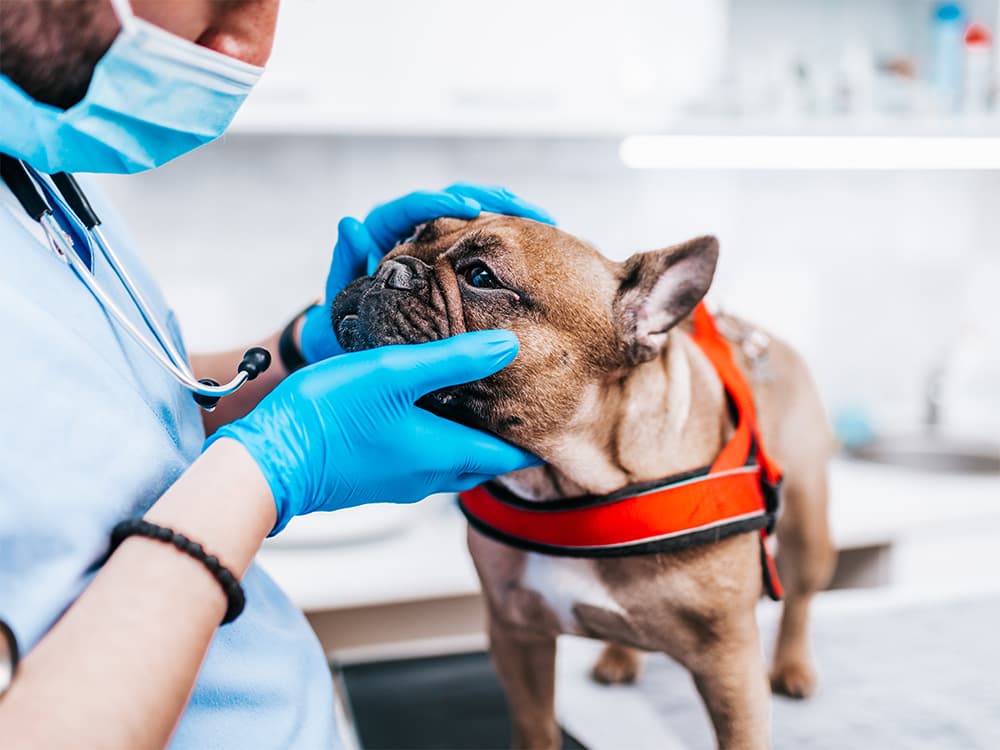
The shorter face of a Frenchie can also lead to several eye disorders. These conditions will usually develop before a French Bulldog is even six months old. Some of these include:
Cherry eye: Cherry eyes involve the protrusion of a gland at the inner corner of a dog’s eye.
Corneal ulcers: Scratches to the surface of the eye, or cornea.
Entropion and Ectropion: Entropion is the inward rolling of a dog’s eyelid, while ectropion is the outward rolling of a dog’s eyelid, possibly with drooping.
Distichiasis: Distichiasis is an abnormal growth of hair on the inside edge of the eyelid.
All of these conditions can cause scratches on the surface of the eye (from the rubbing of hair or eyelashes), dry eye, and poor vision. Other symptoms may include:
Excessive tearing or discharge
Squinting
Redness
Young or new Frenchies should be seen by a vet within a week of coming home with you, so they can be assessed for health issues like these. Abnormal eye issues found early can be fixed with surgeries or managed with eye drops.
The primary skin issue for most Frenchies is allergies. These can be triggered by food or by irritants, plants, animals, and bugs in their environment. When a Frenchie is suffering from allergies, you may see:
Paw licking
Red skin
Rashes
Excessive dandruff
Scratching
Restlessness
Red eyes
Face rubbing
Reverse sneezing
Allergies trigger inflammation in dogs. Once this inflammation takes over, they can quickly develop secondary infections. Here are the most common infections you might notice in your Frenchie.
Ear infections: Head shaking, scratching, scabs on the ear(s) with odor
Eye infections: Excessive eye-tearing, green-to-white mucoid discharge, cloudy eyes
Skin infections: Malodorous skin, hair loss, moist coat or skin, rashes, or bleeding
Anal gland infections: Scooting, ruptured anal glands
Identifying and controlling the underlying allergy is the key to keeping Frenchies comfortable and out of harm’s way. At the first sign of paw licking, speak to your vet before things escalate.
Frenchies are prone to a number of gastrointestinal (GI) related issues and often seem to have sensitive stomachs and be prone to diarrhea.
Allergies: Another symptom of allergies is diarrhea. Any allergen can trigger diarrhea — not just food allergies — so you may not have any other clue about their allergies besides their struggles with stool consistency.
Inflammatory bowel disease: Another similar condition is inflammatory bowel disease (IBD). Triggered not just by allergens but also by foods high in fats, dogs with IBD often need to eat specialized diets that avoid triggering gut inflammation.
Chronic bouts of diarrhea can lead to changes to a French Bulldog’s gut bacteria, causing a condition called dysbiosis. It’s important to take careful steps to get their GI bacteria population back to normal with GI-friendly diets, probiotics, and possibly antibiotics. Without this, Frenchies may suffer from chronic, long-term soft stool or diarrhea, which can even cause vomiting and dehydration. Pancreatitis, another inflammatory condition related to the GI tract, can occur in these situations, continuing to escalate things.
Be sure to consult with your vet when choosing a diet for your Frenchie, especially if they struggle with diarrhea. Starting them on a sensitive skin-and-stomach diet is usually a good idea, but this may not be enough if they have any of the above conditions.
There is a wide variety of neurological conditions that French Bulldogs can suffer from. Some start in the brain, like epilepsy, which is a seizure condition. Others are related to their spine. This is because the way a Frenchie’s head is attached to the rest of their spine can cause them to suffer from pinched nerves, herniations of neurological tissue, poor production (or drainage) of nervous system-related fluids, and unstable or incorrectly formed spinal bones that shift and cause sudden paralysis.
One of the most common spinal conditions in French Bulldogs is intervertebral disc disease (IVDD). French Bulldogs are often born with hardened discs between their backbones that can break, move (herniate), and even harm the spinal cord.
Signs of IVDD include:
Sudden episodes of crying or screaming when at rest
Turning to look at, chew, or cry at their back or side
Limping
Crying or screaming when being picked up
Vocalizing when jumping down
Weakness in the back legs or all legs
Loss of control of the back legs or all legs
Urinary or fecal incontinence
Sudden paralysis
If you are concerned that your Frenchie might be showing signs of a neurological condition, it’s important to speak to a veterinarian as soon as you notice a problem. Many French Bulldogs will need to see a neurologist in their lifetimes, and sometimes it is best to establish a relationship with one in your area early, especially if your Frenchie is diagnosed with any spinal abnormalities.
French Bulldogs are prone to a number of conditions affecting their bones and joints, which can cause them pain over time.
Luxating patellas: Luxating patella is common across all small-breed dogs — it causes their kneecaps to move around their knee joint, resulting in arthritis if not corrected.
Hip dysplasia: Another is hip dysplasia, which is especially prevalent in Frenchies with very short legs and/or very short torsos. Hip dysplasia is caused by loose hip joints that degenerate over time. This can be very painful and also contributes to arthritis in other joints across their body.
Like many of their other body systems, a check-in with a vet can help identify whether your Frenchie has any of these conditions and whether surgery is recommended.

LIGHTFIELD STUDIOS / AdobeStock
Due to French Bulldogs’ short faces, there isn’t enough room in their mouths for all of their anatomy. We already talked about all the soft-tissue structures in their mouth that get in the way of breathing easily — but they also don’t have enough room for all their teeth. Overcrowding leads to tartar and gingivitis, tooth root exposure, and abnormal alignment (including, most often, an underbite).
Dental hygiene via tooth brushing and dental chews is very important, so French Bulldogs can avoid numerous dental procedures over their lifetimes.
Since dogs cannot sweat, they rely on panting to cool down. The problem for Frenchies is that they cannot move air easily unless they have BOAS surgeries — therefore, they have a lot of trouble cooling down and are at higher risk for heat stroke. Frenchies should not go for walks in the middle of the day in warm weather, should not go for runs, and cannot be left outside in warm weather for more than a few minutes at a time. BOAS surgeries can help with this, but it is still important to make sure your Frenchie has ready access to water and a cool place to lie in warm weather.
Loving a Frenchie is easy, but keeping them healthy can be hard work.
Get pet insurance: Start by carefully researching pet insurance options and choosing one that meets your needs.
Connect with a vet: Maintain all annual health screenings with your veterinarian.
Manage their weight: You should also make sure your French Bulldog stays at a healthy and lean weight, which your veterinarian can counsel you on.
Feed a healthy diet: Choose a diet that meets your French Bulldog’s needs. It’s important to understand your particular Frenchie’s food sensitivities — whether that’s specific proteins, fats, or fiber levels — and choose a diet that includes and avoids key ingredients.
Consult about BOAS surgeries: Receiving BOAS surgeries before the age of two can significantly improve a French Bulldog’s quality of life as well as their lifespan. Seriously consider even one or two recommended procedures (if not all of them), to help your Frenchie live a long, comfortable, and healthy life.
Common French Bulldog skin conditions are allergies with secondary skin infections, which might include ear infections, too.
The biggest French Bulldog breed problems include their serious, chronic, and expensive health issues, such as obstructive airway conditions, allergies, hip dysplasia, and eye issues, among others.
You should be cautious about leaving your French Bulldog in temperatures above 80-85 degrees unsupervised or for more than five to ten minutes. Humidity and access to shade can affect this as well.
Because Frenchies have large heads on little bodies, in most cases, they cannot pass through a mother’s birth canal. French Bulldogs need to be delivered by C-section to have a healthy birth. This can be expensive and should be taken into consideration by anyone considering keeping their French Bulldog intact.
“American Kennel Club.” American Kennel Club, 6 Nov. 2017, www.akc.org/dog-breeds/french-bulldog.
Geraz, Helena, et al. “Investigating the Life Expectancy at Birth of Companion Dogs in Portugal Using Official National Registry Data.” Animals, vol. 14, no. 15, 23 July 2024, p. 2141, doi.org/10.3390/ani14152141.
Mara, et al. “Health Status and Disease Prevalences in French Bulldogs in Germany: Insights from a Survey-Based Study.” Companion Animal Health and Genetics, vol. 12, no. 1, 31 Oct. 2025, doi.org/10.1186/s40575-025-00149-8.
“Pathophysiology of BOAS.” www.vet.cam.ac.uk, www.vet.cam.ac.uk/boas/about-boas/pathophysiology.
Teng, Kendy Tzu-yun, et al. “Life Tables of Annual Life Expectancy and Mortality for Companion Dogs in the United Kingdom.” Scientific Reports, vol. 12, no. 1, 28 Apr. 2022, p. 6415, www.nature.com/articles/s41598-022-10341-6, doi.org/10.1038/s41598-022-10341-6.
Dr. Maria Zayas attended Ross University School of Veterinary Medicine where she completed her veterinary degree in addition to participating in and presenting research related to aquatic animal medicine. She spent her first year as a doctor working with a low cost spay/neuter and general practice clinic before returning to her home state of New York and entering the world of housecall veterinary medicine. Falling in love with this area of medicine, she launched her own housecall veterinary practice in addition to writing pet health articles. She loves all things related to water and continues to travel and explore with her three dogs and one cat, all of whom also love to swim.
Adoption Advice

Breed Info

Breed Info

Breed Info
From Pugs to French Bulldogs, squishy-face dogs are pretty hard to resist. Here is your guide to these loving, adorable breeds.

Adoption Advice
It’s basically a safe space to comfort your pup.

Adoption Advice
Thinking about adopting one of these perfectly adorable pups? Here are more names that you could dream of, for inspiration.

Adoption Advice
We all think our pups are stars. Here are some celebrity-related name ideas aimed at doing justice to their canine X factor.

Adoption Advice
Finding the right crate size is important. But so is considering your dog’s age, circumstances, and training goals. Our guide is here to help.