What’s the Difference Between a Malamute and a Husky?
Just because they kind of look alike doesn’t mean they are the same.
Just because they kind of look alike doesn’t mean they are the same.
by Janelle Leeson, | February 10, 2026
blickwinkel / Alamy
Picking a pup who fits into your everyday life sets you both up for a lot of happiness down the road. Luckily, using resources like Adopt a Pet — alongside spending time meeting shelter pups (or chatting with foster families) — can make the process easier and more enjoyable. This way, you get to know different breeds before you commit. If you’ve narrowed your adoption search down to an Alaskan Malamute versus a Siberian Husky, you’re looking at two iconic Arctic sled dogs.
They’re both working dog breeds who love to be active, but there are some important differences between them that are definitely worth exploring.

Spitz-type dogs, including Siberian Huskies and Alaskan Malamutes, are often considered some of the closest modern relatives to ancient wolves. Long ago, humans and wolves hunted the same large prey and moved through the same territories, meaning they regularly crossed paths. Some of the bolder wolves discovered that sticking close to human camps had its advantages: namely, food scraps.
At first, people simply tolerated these scavengers, but over time, they realized the animals’ value. As wolves grew tamer, slowly evolving into early dogs, humans began to rely on them for their strength, endurance, and sharp senses.

Can having a pet help reduce stress, anxiety, and depression? Absolutely—and the research proves it.
Siberian Huskies trace their roots to the Chukchi people, an indigenous group from far northeastern Siberia. The Chukchi selectively bred their dogs for stamina, tolerance to the cold, and efficiency. The result was a medium-sized sled dog capable of pulling light loads across long distances.
Alaskan Malamutes, on the other hand, developed alongside the Mahlemiut Inuit people near the Kotzebue Sound in what’s now northwest Alaska. Instead of speed, Malamutes were bred for power. These large, strong dogs hauled heavy freight and assisted in hunting by distracting polar bears and locating seal breathing holes.

Impact Dog Crates / Pexels
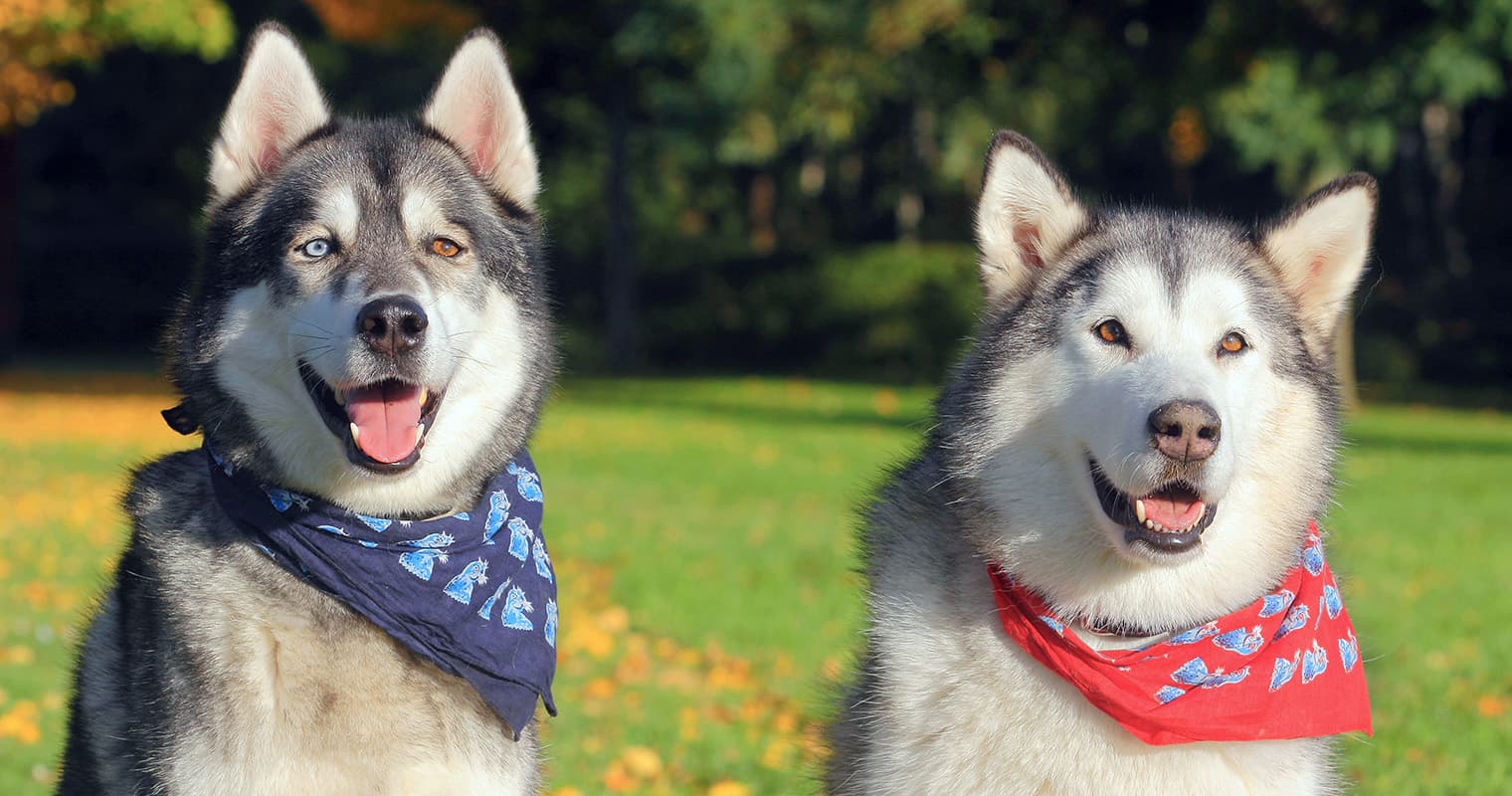
At first glance, Siberian Huskies and Alaskan Malamutes look pretty similar. Once you know what to look for, though, their differences are easier to spot. From overall size to facial features, these Arctic breeds are built for different kinds of work.
Siberian Husky: Medium-sized breed with an athletic, compact build bred for speed and endurance
Alaskan Malamute: Large-sized breed with deep chests and powerful, muscular bodies bred for hauling heavy loads
Siberian Husky: 21 to 23 inches tall, 34 to 67 pounds Alaskan Malamute: 23 to 28 inches tall, 61 to 105 pounds
Siberian Husky: They have a narrow, fox-like snout. They can look like they’re smiling when their tongue lolls out. Their facial markings often create the look of expressive, raised eyebrows, often with a white stripe running vertically up their foreheads.
Alaskan Malamute: They have a broad, bear-like snout. Their facial markings often create the look of expressive, raised eyebrows with a solid-colored cap that tapers to a point.
Siberian Husky: High-set, triangular ears that sit fairly close together
Alaskan Malamute: Triangular ears that are small in proportion to their head, set wide apart with slightly rounded tips
Siberian Husky: These dogs have almond-shaped eyes, which can be blue, brown, or amber. Some Huskies have heterochromia (one blue eye and one brown eye) or parti-colored eyes that are half blue and half brown.
Alaskan Malamute: They have almond-shaped eyes that are always brown.
Siberian Husky: A long, fluffy tail that fans out behind them like a brush
Alaskan Malamute: A long, fluffy tail that curls over the back
Aside from keeping your dog pretty or handsome, grooming is an important part of maintaining their health. Here are some tips on knowing when your pup needs a little freshening up.
Siberian Husky: They come with a thick, medium-length double coat with a soft, dense undercoat and a coarser outer layer. Huskies are heavy shedders and may lose most or all of their undercoat in spring and summer. Coat colors include black and white, gray and white, red and white, agouti, sable, brown and white, and solid white. A white stripe runs vertically up their foreheads.
Alaskan Malamute: They come with a thick, medium-length double coat with a coarse, shorter topcoat and a dense, often woolly undercoat that may feel slightly oily. Their fur is shorter along the sides of the body and longer on the shoulders, neck, back, and rear. Malamutes are heavy shedders and typically blow most of their undercoat during seasonal shedding, which usually occurs twice a year. Their underside is typically white from chest to tail, while the topcoat can be black, gray, red, sable, silver, blue, brown, or seal. A solid white coat is less common and is the only solid-color variation you’ll find in this breed.

pavlobaliukh / Adobe Stock
Dogs have been selectively bred for thousands of years, which is why pups within a breed share recognizable looks and general personality traits. Typically, those traits are tied to the jobs they were bred to do.
However, temperament isn’t set in stone. Life experience, training, environment, and age all play a big role in a pup’s personality and temperament. Adopting an older dog gives you a clearer idea of their personality and behaviors, while adopting a puppy offers more opportunity to help shape who they’ll become.
Based on breed standards, here’s what you can typically expect from an Alaskan Malamute versus a Siberian Husky.
Alaskan Malamute personality and temperament:
Loyal
Affectionate
Intelligent
Friendly
Outgoing
Playful
Willful
High exercise needs
Good with kids
Good with other dogs
Not always good with cats
Not a good guard dog
Vocal, using yelps, howls, and “woo woos”
Siberian Husky personality and temperament:
High-energy
Affectionate
Friendly
Outgoing
Playful
Willful
High exercise needs
Good with kids
Good with other dogs
Not always good with cats
Not a good guard dog
Vocal, using screams, howls, and chuffs
Siberian Huskies and Alaskan Malamutes have similar life spans. The Siberian Husky lifespan is about 12 to 15 years, while the Alaskan Malamute lifespan typically ranges from 10 to 14 years. With regular exercise, a balanced diet, and consistent veterinary care, you can help them enjoy long, healthy lives.
Both breeds are prone to a few common — though often manageable or preventable — health conditions.
Hip dysplasia occurs when hip joints don’t align properly, potentially leading to early-onset arthritis, pain, and mobility issues. Maintaining a healthy weight can help reduce strain on the joints.
Bloat (gastric dilatation-volvulus) is a life-threatening condition where gas builds up in the stomach, putting pressure on other organs. Avoid exercising your dog immediately before or after meals to help reduce risk.
Cataracts are a clouding of the eye that can obstruct vision. Huskies are especially prone to juvenile cataracts, which may be managed with medication or, in severe cases, surgery.
Corneal dystrophy is a buildup of fat, calcium, cholesterol, or fluid in the cornea that causes cloudiness. This condition doesn’t always require treatment, but should be monitored by a veterinarian.

A major part of pet parenthood is financially planning for your pet’s future. Here’s a guide to get you on track.
Hip and elbow dysplasia occurs when the hip and/or elbow joints don’t align properly, potentially leading to early-onset arthritis, pain, and mobility issues. Maintaining a healthy weight can help reduce strain on the joints.
Osteochondrosis dissecans (OCD) is an abnormal growth of cartilage in the joints, most commonly affecting the shoulders or elbows. Feeding a dog an appropriate diet during growth may help reduce this condition.
Patellar luxation occurs when the kneecap slips out of place, which can cause lameness or discomfort. Maintaining a healthy weight can help reduce strain on the joints.
Progressive retinal atrophy (PRA) is a genetic eye disease that leads to gradual vision loss and eventual blindness. There is no cure, but reputable breeders test for PRA to avoid passing it on.
Inherited polyneuropathy is a genetic disorder affecting the nerves, leading to weakness, loss of coordination, and reduced pain sensation. Although there is no cure, reputable breeders screen for this condition.
Good news: adoptable Siberian Huskies and Alaskan Malamutes can often be found through local shelters, rescues, and breed-specific rescue groups.
A great place to start your adoption journey is at Adopt a Pet, where you can search by breed using the drop-down menu and even filter by age or other preferences. Each adoptable pet profile includes a description that helps you get to know their personality and needs.
Still deciding between a Siberian Husky, an Alaskan Malamute, or one of their mixes? Continue learning more about them by exploring breed profiles for Huskies and Malamutes, as well as many other breeds, including other pups within the Spitz dog family.
Size and build are the biggest clues distinguishing a Siberian Husky from an Alaskan Malamute. Siberian Huskies have long legs and a medium-sized, compact frame built for speed, while Alaskan Malamutes are larger and heavier, with a broad chest and a powerful, athletic build. Meanwhile, a Malamute’s tail curls over their back, while a Husky’s fluffy tail tends to fan out behind them. Additionally, Huskies often have a white streak down their forehead, while Malamutes have a solid-colored cap that tapers to a point. If you’re lucky enough to get a belly rub invitation, a Malamute has an all-white underside, while a Husky’s coat pattern continues across their belly.
While Malamutes and Huskies both have a “work hard, play hard” attitude and high exercise needs, their energy shows up a bit differently. Siberian Huskies were bred for speed and stamina, which means they tend to be “go-go-go” and thrive on intense, high-energy activities. Alaskan Malamutes, on the other hand, were built for power rather than speed and usually prefer a slower pace, such as hikes rather than runs. Neither breed makes a great guard dog: They’re far more likely to greet strangers as part of the pack. That said, both can be great family dogs for active households with kids and other dogs. Both breeds have a strong prey drive, which means they aren’t typically among the best dogs for homes with cats. When it comes to vocalizations, Huskies are known for groans, whines, and chatty commentary, while Malamutes are famous for their signature “woo-woo” sounds.
Brown, S., Darwent, C., Wictum, E. et al. Using multiple markers to elucidate the ancient, historical, and modern relationships among North American Arctic dog breeds. Heredity115, 488–495 (2015). https://doi.org/10.1038/hdy.2015.49 https://www.nature.com/articles/hdy201549.
Peplinski, L. The dogs of the Inuit: companions in survival. Food and Agriculture Organization of the United Nations. https://www.fao.org/4/w0613t/w0613t0m.htm.
Ryabinina, O.M., Politov, D.V. Origin of Domestic Dogs in Light of Recent Genetic Data.Russ J Genet 61, 1210–1220 (2025). https://doi.org/10.1134/S1022795425700747 https://link.springer.com/article/10.1134/S1022795425700747.
Skoglund, Pontus et al. Ancient Wolf Genome Reveals an Early Divergence of Domestic Dog Ancestors and Admixture into High-Latitude Breeds. Current Biology, Volume 25, Issue 11, 1515 - 1519. https://academic.oup.com/gbe/article/16/9/evae190/7742946.
Tracy A Smith, Krishnamoorthy Srikanth, Heather Jay Huson, Comparative Population Genomics of Arctic Sled Dogs Reveals a Deep and Complex History, Genome Biology and Evolution, Volume 16, Issue 9, September 2024, evae190, https://doi.org/10.1093/gbe/evae190.

Janelle Leeson is a Portland, Oregon-based freelance writer. Her work has been featured in magazines such as Inside Your Dog’s Mind, Inside Your Cat’s Mind, and Paw Print, as well online at Insider Reviews, NBC Select, Shop Today, PetMD, and Daily Paws. She has two adventure cats, a flock of urban chickens, and a soon-to-be-husband who doesn’t mind housing the occasional foster cat — or five.
Breed Info

Pet Wellness
Breed Info

Adoption Advice
Finding the right crate size is important. But so is considering your dog’s age, circumstances, and training goals. Our guide is here to help.
Breed Info
If you love being outside and are looking for a pup who’ll share in that enthusiasm, check out these dogs who are happiest when they’re active.

Breed Info
Looking for a pup to match your lifestyle? These are the top canine companions of the year, perfect for everyone from adventurers to couch potatoes.

Breed Info
Energetic, clever, and bold, this pup is a perfect match for an active, adventure-loving family.

Breed Info
Meet the dog breeds who got their start on American soil.
Adoption Advice
Aside from keeping your dog pretty or handsome, grooming is an important part of maintaining their health. Here are some tips on knowing when your pup needs a little freshening up.