Why Cats Groom and Rub Against Each Other (and What It Really Means)
Everything you need to know about allogrooming and allorubbing — why cats do this, what it means, and why it’s important.
Everything you need to know about allogrooming and allorubbing — why cats do this, what it means, and why it’s important.
by Rachel Pick, | August 3, 2026
Linda Raymond / iStock
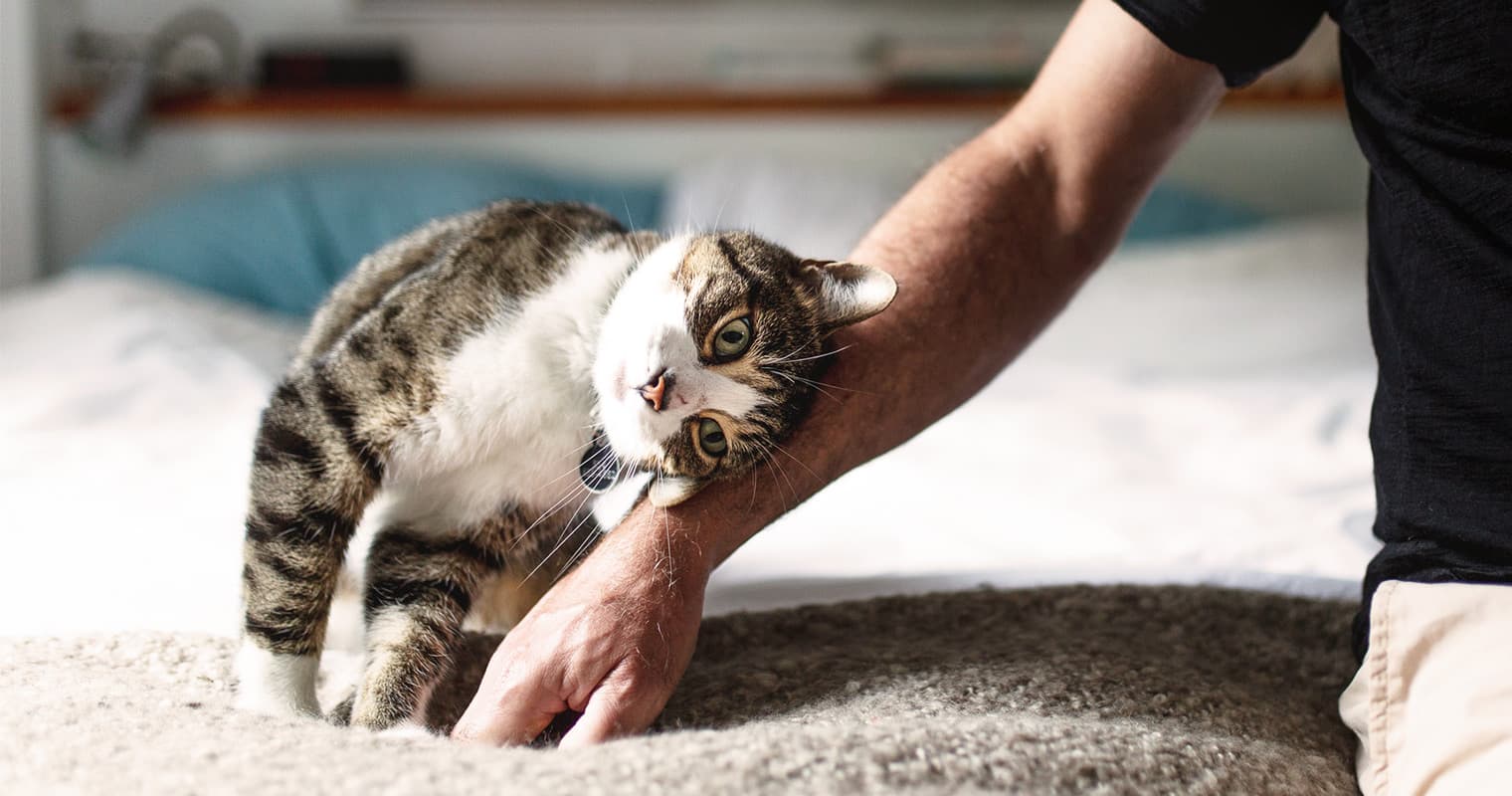
Right now, my cat, Cowboy, is repeatedly marching back and forth across my desk, hitting me in the face with the sides of his body, and headbutting my hands at the keyboard and licking me. Thanks to him, typing the previous sentence took me about six times longer than it normally would. But he’s not doing this just to be irritating. He’s engaging in two common, fundamental feline behaviors: allorubbing and allogrooming.
Allorubbing is the scientific term for an animal rubbing part of their body on another individual, and is a common practice among all species of cats, both wild and domesticated. Similarly, allogrooming is when cats groom or lick each other. Both behaviors are common among cats, and both are worth understanding if you want to know what your cat’s actually telling you.
If you’ve done any reading on cat behavior, you may already know that scent is the primary way cats navigate their surroundings and social interactions. Not only is a cat’s sense of smell thought to be 14 times stronger than a human’s, but cats also have a secondary olfactory organ called the vomeronasal organ, which is used to detect pheromones. (This special feature is not unique to cats — many mammals, as well as all snakes and lizards, have this organ.)
Cats also have an extensive network of scent glands on their bodies — particularly on the face, paw pads, and at the base of the tail — used for depositing pheromones.
Together, these two systems allow cats to communicate in a natural olfactory language that is completely undetectable by human beings. When cats groom each other, they’re not just cleaning up — they’re also transferring and mixing scent between each other, which reinforces that same sense of “you smell like me, so you’re part of my group.” So while rubbing and grooming look like pretty different behaviors on the surface, they’re both communicating using the same system.
amaliacoyle / iStock
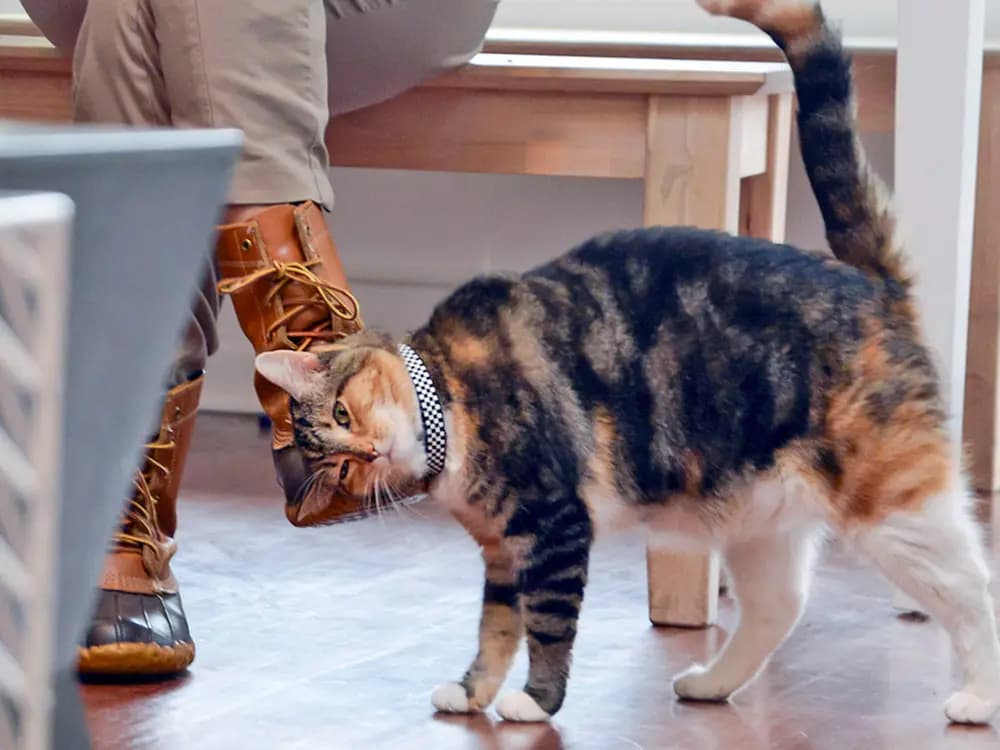
Pheromones can convey a variety of different messages between animals. But within a standard home environment, your cat is most likely using their scent marking abilities to communicate one of two very similar sentiments: “This is mine,” or “You are family.” As a kitten, the smell of your cat’s “nest” — the primary den area containing their nursing mother and littermates — created what some researchers call an “olfactory secure base” or “colony scent.” So, your cat has learned to seek comfort in familiar scents from their earliest days. By rubbing their scent glands on you (or on other objects and individuals in your household) via allorubbing, they are making you smell like them and establishing a calming and familiar feedback loop.
Feline behaviorist Stephen Quandt stresses how crucial this scent communication system is to cats, in particular. Although cats live in social groups, he says, they don’t have as many communication tools or social skills at their disposal as dogs do, so they rely even more on this scent-based socialization and reassurance.
One very common form of allorubbing that you may have observed in your own cat is colloquially termed “head bunting” or “headbutting,” where the cat gently bumps their head and face into you. This is considered the most affectionate form of allorubbing, because a cat who buries their face against your hand or presses their head to your chin is choosing to be physically vulnerable with you.
“The scent that is released from [different] glands serves different purposes,” Quandt says. The scent glands in paw pads, he explains, are thought to be used more for territory-marking, such as when your cat scratches a post (or your furniture). But Quandt says that the scent glands located in the cheeks, the chin, and the forehead contain social scents. “These are scents that cats give off when they want to communicate some degree of social connection. Cats transfer these scents in order to communicate social feelings, and the sense of who’s family and who’s not family. And that can be done from cat to cat, or it can be done from cat to human.”
But when cats rub against their human companions, the distinction between whether the cat is simply “claiming” them or showing trust and love is a very fine, nebulous line. Some would even argue it’s essentially the same thing. “It’s friendly, and it’s sweet, but they’re also claiming you, marking you as their person,” cat behaviorist Jennifer Van de Kieft says.
kathomenden / Adob
If you want to figure out what your cat’s behavior means, look at the circumstances surrounding the behavior.
A cat who rubs against you the moment you walk in the door is likely greeting you and re-establishing that comforting scent connection after a period of absence. However, a cat who rubs on a new object you’ve brought into the house is probably just trying to make it smell less foreign.
You can also figure out the purpose of your cat’s allorubbing just through some simple observation. For example, both of my cats rub their faces on my hands when they want my attention and affection, and they do this whenever my hands are occupied by something else — like my phone, a keyboard, a gaming controller. (Many times I have been lying in bed looking at my phone, and an aggressive headbutt has caused me to drop it onto my own face.)
And what they’re trying to tell you when they do.
My older cat, Cricket, frequently rubs herself against my furniture, most likely to reassert her position as the queen of the house, three years after I adopted Cowboy. Meanwhile, Cowboy takes it upon himself to personally investigate and rub himself on every bag of groceries or package I bring into the house, a habit that I affectionately refer to as “quality control.”
“There’s a little bit of nuance, because sometimes it’s a social-bonding thing and sometimes it’s a reassurance and territory-marking thing,” Van de Kieft says. “This is always in the context. We can make generalizations about it, but every individual cat [is different].”
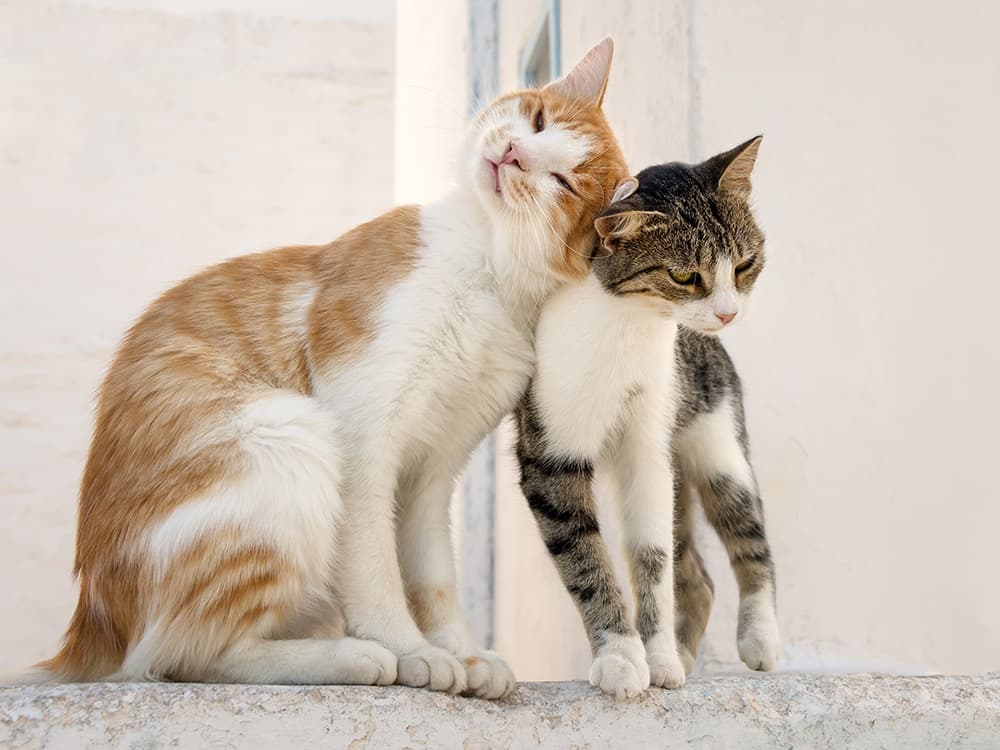
Like allorubbing, allogrooming also spreads scent, but it is also about maintenance and trust. You’ve probably seen this if you have multiple cats when one parks themselves next to the other and gets to work on their ears or the back of their neck, and the other just... lets it happen.
Grooming a spot your cat can’t easily reach themselves, such as the top of their head, is a pretty vulnerable position for a cat to accept from another animal. So when your cats groom each other, they’re telling each other they feel safe enough to let their guard down. And the behavior isn’t limited to cat-on-cat interaction, either.
If your cat has ever given you a few sandpapery licks on the hand or arm, congratulations: they’ve folded you into their grooming rotation, which is about as clear a sign of trust as a cat can give.
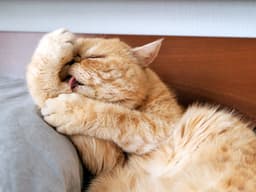
They are adorable little neat freaks.
Ultimately, allorubbing and allogrooming are one of the most genuine and critical forms of social communication cats have, rooted in their complex biology and helping them acclimate to and navigate their surroundings. Even if it’s not always done to you at the most convenient times — like when you’re trying to write an article, for example — it’s always a major feline compliment to be considered worthy of their scent. So be glad your kitty is welcoming you into their posse.
van den Bos, Ruud. “The Function of Allogrooming in Domestic Cats (Felis Silvestris Catus); a Study in a Group of Cats Living in Confinement.” Journal of Ethology, vol. 16, no. 1, Springer Science and Business Media LLC, Mar. 1998, pp. 1–13, https://doi.org/10.1007/bf02896348. Accessed 28 July 2026.
Belle, Van, et al. “Unravelling Feline Social Dynamics - A Video-Based Observational Study on Allogrooming in Domestic Cats.” Applied Animal Behavior Science, vol. 301, Elsevier BV, May 2026, pp. 107038–38, https://doi.org/10.1016/j.applanim.2026.107038.

Rachel Pick is a freelance writer and social media editor who has written for Vice, The Guardian, and SELF. She lives with two cats: Cricket, a genteel lady who is the picture of refinement, modesty, and good manners; and Cowboy, who is an agent of chaos, slapstick comedy, and foul odors. Her work here frequently focuses on cat companionship and cat behavior.
Behavior & Training
Behavior & Training
Behavior & Training
Behavior & Training
All that cat hair on your pants is just a bonus.

Behavior & Training
They may not be able to say it—but they can definitely show it.
Behavior & Training
It’s not all in your head.